

|

|
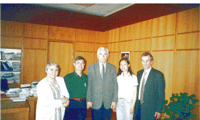
Meet With Витязъ П А,Vice President of the Academy of Sciences of Belarus |
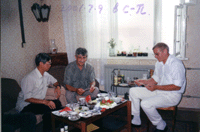
At Friend's home with ND Authority |
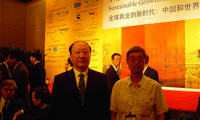
At the Asian Enterprise Annual Conference, met with Mr. Xu Kuangdi, Dean of the Engineering Institute |
||||
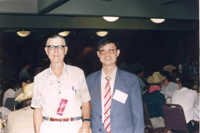
take photo with F.BUNDY |
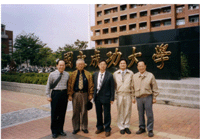
Visit Taiwan National Cheng Kung University |
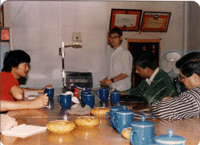
Lecture to Pakistan Experts |
||||
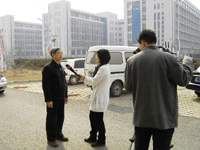
In an TV interview |
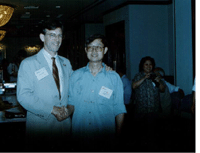
Meet with the CEO of The New York Academy of Science |
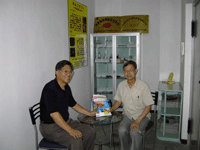
With Li Zhihong,Secretry of Superhard Material Assosiation in job inspection |
||||

In Osaka Expo |
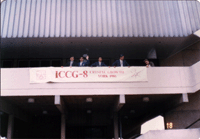
In Crystal Growth York |
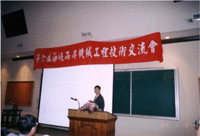
Make speech in university in Taiwan |

|
|
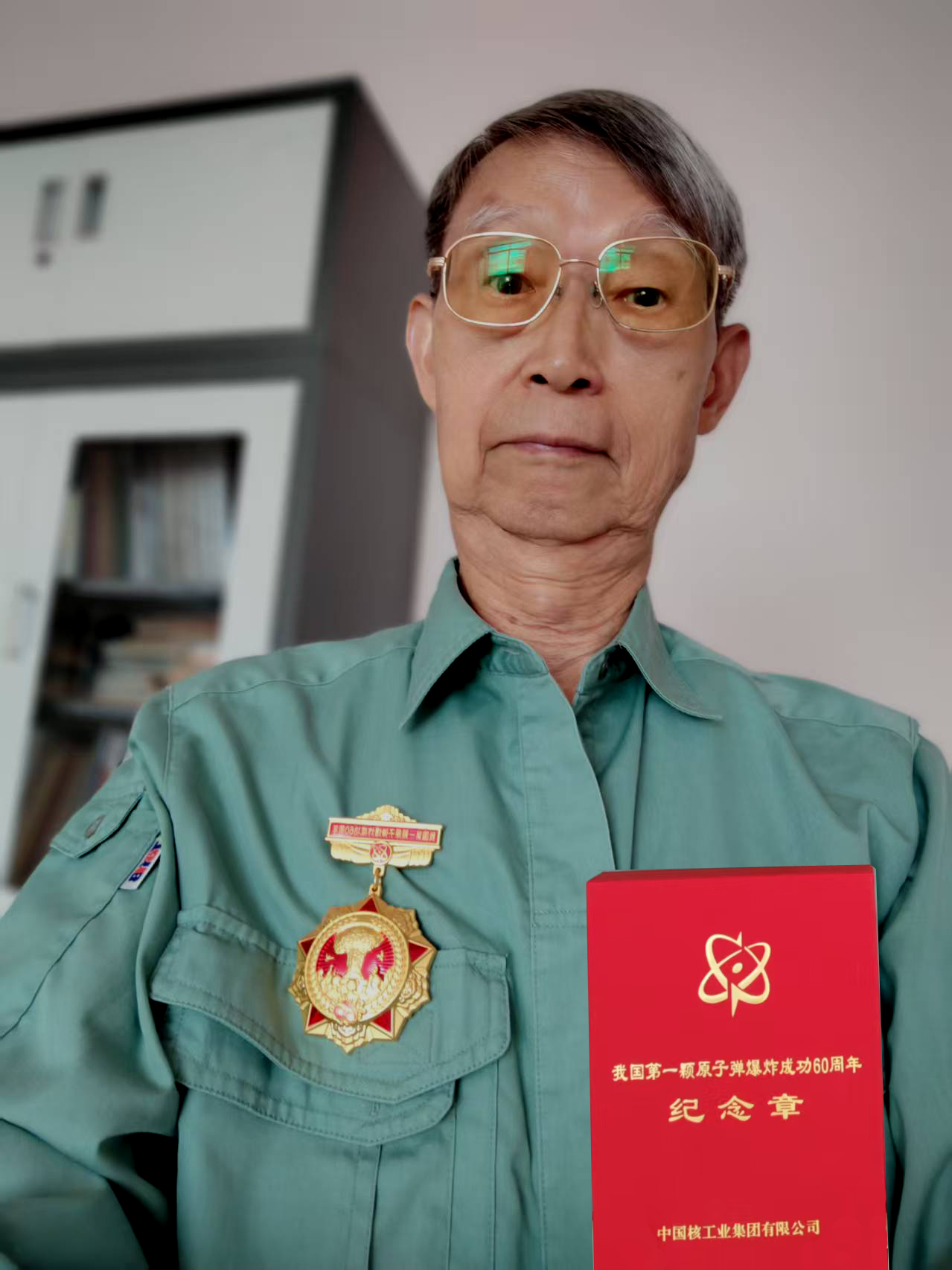
Mr. ZHANG Shuda, male, born in January 1941, is of Han ethnicity and from Tianjin. He is a professor-level senior engineer and General Manager of Tianjin Chanyu Superhard Sci-Tech Co., Ltd. He is also an honorary member of the Superhard Materials and Products Professional Committee of the Chinese Materials Research Society. Professor Zhang enjoys the special government allowance issued the State Council and the "Ninth Five Year Plan" Merit Medal issued by the Tianjin Federation of Trade Unions. In 1964, he graduated from Beijing Normal University with a degree in Solid-State Physics. His research has focused on thin film conductivity, radioactive analysis, nuclear radiation detectors and nuclear electronics, the production of synthetic diamond monocrystal, polycrystals, and micro powders, high pressure physics, material physics, and nanodiamonds. He has attended numerous important academic conferences both domestically and internationally, and has published multiple papers in authoritative journals. Professor Zhang has long been engaged in research work in the nuclear industry, holding positions such as the technical leader of the Physics Group of Hunan No. 230 Research Institute of Nuclear Industry, the director of the Diamond Workshop of State-owned No. 232 Factory, and the director of Tianjin Superhard Abrasive Research Center. He was appointed as a collaborative member of the International Center for Material Physics of the Chinese Academy of Sciences, an active member of the New York Academy of Sciences, a member of the American Physical Society, an international member of the American Association for the Advancement of Science, a member of the Tianjin University Nanometer Center, a special technical consultant of the China Science and Technology Talent Development Center, and a consultant of the National Technical Committee for Abrasive and Grinding Tools Standardization. After experts evaluation, “the Modified Nanodiamond Engine Oil” developed by him was recognized as “Internationally Leading”; “Diamond Polishing Suspension” was recognized as “Internationally Advanced Level”. He was awarded the 60th Anniversary Commemorative Medal for the Successful Explosion of China's First Atomic Bomb. 1、 Diamond, Materials Physics, and Nanotechnology 1.1 Obtaining provincial or ministerial level or above science and technology awards. (1) “The Lion” brand synthetic diamond micro powder; The National Economic Commission awarded it as the Excellent New Product Flying Dragon Award in 1983; Category level: International level. (2) MBD series synthetic diamond monocrystal; In 1988, awarded by the National Economic Commission; National Quality Award; Category level: National Silver Medal. (It was the highest award for this type of product at that time.) (3) A new process for manufacturing diamond micro powder - SDZ method; In 1999, the Tianjin Municipal People's Government awarded the Tianjin Science and Technology Progress Award; Category level: Second Prize for Invention. National level achievement. (4) Modified nanodiamond engine oil; In 2007, Tianjin Municipal People's Government awarded the Tianjin Technical Invention Award; Category level: Third Prize. (5) Energy saving and environmentally friendly nano diamond engine oil; In 2008, China Machinery Industry Federation and China Mechanical Engineering Society awarded the China Machinery Industry Science and Technology Award; Category level: Third Prize. (6) Energy saving and environmentally friendly nano diamond engine oil; In 2008, the Organizing Committee of the Cross-Straits Workers’ Innovation Achievements Exhibition presented the Gold Award for the Cross-Straits Workers’ Innovation Achievement Exhibition. 1.2 Experimental Innovation During his employment as a collaborative member of the International Center for Material Physics of the Chinese Academy of Sciences, he has successively completed three scientific research achievements: the depth distribution of impurities on diamond surface; the influence of non-uniform crystal structure on diamond crystal form; and the destructive effect of perchloric acid on diamond. During his employment as a technical consultant for Hebei Kuancheng Manchu Autonomous County Diamond Co., Ltd., he guided them to complete the provincial-level scientific research project (No. 91212137), and passed the provincial-level appraisal (No. 92 Jikejianzi 150). The product was recognized as a high-tech product in Hebei Province (product code No. 06-0046). In 1986, he first introduced the process overview of diamond production using six-sided press machine in China and some new phenomena we discovered at an international academic conference. He has deeply researched on the physical and chemical properties of nanodiamonds, solved the world problem of stable suspension of nanodiamonds in engine oil. Experts have identified it as an international leading level. He has developed water-based and oil-based diamond grinding and polishing suspension, which has been identified as Internationally Advanced Level by experts. In his patent ZL 02 2 33033.X, he publicly disclosed that the inner hole of the pressure transmission medium used in manufacturing superhard materials with a six-sided pressing machine should be changed from circular to square. This change results in a more reasonable distribution pressure and temperature within the synthesis chamber, significantly improving product quality. Additionally, the volume of the synthesis chamber is increased by 27%, leading to a corresponding increase in per unit yield of synthetic diamond and a doubling of economic benefits. He was the first using air jet milling to produce diamond micro powder in China in 1994, and exported diamond micro powder in large quantities to developed countries and regions such as the United States. He publicly announced this method at the international conference in 2000, which has been widely applied, greatly improving labor productivity and saving energy and benefiting the environment. He completed a special surface treatment for electroplated diamond in 1984. 1.3 Theoretical Exploration He summarized the impurity content and existing forms in synthetic diamond, and the distribution patterns of inclusions; pointed out the way to improve monocrystal diamonds, which can be graded through magnetic separation. He discovered that molten pyrophyllite had a certain catalytic effect, which could serve as a nucleation matrix for diamond and promote its growth, and the diamond crystal shape grown on it was complete. He revealed the distribution pattern of impurities on the surface of synthetic diamond, especially in terms of depth, with the maximum concentration of various impurities located within a thin layer on the outermost surface. He developed a new theory of "non-uniform surface structure free enthalpy", which effectively explains the contradiction between the synthetic diamond crystal structure and the current Gibbs Wulf law theory. He calculated the relationship between the entropy of crystal structures on different crystal planes, with S100st-S110st>0.0166 mJ/K.m. He proposed the different mechanisms of diamond growth by static pressure catalyst method at different stages. This well explains the contradiction between the solvent dissolution crystallization mechanism and catalytic mechanism and the reality of diamond growth. For the first time, he observed the concave leaf vein-like growth stripes on the surface of monocrystal diamond grown on by static pressure catalytic method, with a width of about 0.1-0.5μm and a spacing of about 2-10μm, further revealing the microscopic mechanism of diamond growth by static pressure catalytic method. He systematically studied the mechanism of laser-induced synthesis of diamond. For the first time, he estimated that the barrier value for the direct conversion of graphite to diamond is 8.565 × 10⁴J.mol-1. This indicates that macro high pressure is not a necessary condition for this transformation. For laser-induced synthesis of diamond, the power density of the laser source should not be less than 2.534 × 10⁵W.cm-2. He proposed and calculated several factors favorable for laser-induced synthesis of diamond: the pressure of the detonation wave maintained by the laser in front of the target can reach several GPa; the surface high pressure of graphite particles with a particle size of 4nm can reach 3.32GPa; After being heated, the thermal pressure of graphite crystal can reach hundreds of MPa; The atomic amplitude on the crystal surface is much larger than in the body, with its kinetic energy reaching 1.6×10⁻¹⁹J; when irradiated by laser, the average amplitude of graphite atoms is more than 8 times that at room temperature. Using fine graphite particles as raw materials makes it easier to synthesize diamonds. Combining macroscopic thermodynamic theory with microscopic material structure and the microscopic mechanism of phase transition can better elucidate the mechanism of this phase transition. He put forward the theory of "Reducing Friction and Anti-wear by Adding Nanodiamond", which made the reducing friction and anti-wear mechanism of nanodiamonds leap from qualitative analysis to a combination of qualitative and quantitative analysis. He is the first drafter of the industry standard JB/T 11765-2014 “Superhard abrasive Nanodiamonds”. He is the second author of the industry standard JB/T13947-2020 “Superhard abrasive products ---- Nanodiamond extreme pressure and anti-wear agents” (the first author is Zhang Wengang from our company). 2、 Radioactive analysis, nuclear radiation detectors, and nuclear electronics As the technical leader of the physics group at Hunan No. 230 Research Institute, he organized his colleagues to vigorously innovate. After years of hard work, all the processes formulated and implemented by Soviet experts over more than a decade were replaced with innovative processes. The following items were all participated in as the first participant. 2.1 Deep uranium exploration using 210Pb (RaD) He conducted a comprehensive theoretical analysis of its scientific validity, collaborated with geophysical exploration experts to study its practicality, and agreed on the experimental plan, which represents a new method for deep uranium exploration. Zhang Qingwen, a State Council Special Expert, and his team carried out extensive fieldwork and sample analysis, ultimately achieving significant results. This research has been promoted as a key scientific achievement in the nuclear industry. 2.2 Development of a specialized electronic computer for scintillation measurement of uranium and radium This was the first officially approved ministerial-level scientific research project of Hunan No. 230 Research Institute, which was received a research fund of 50000 yuan in 1975. He personally managed the entire process, from feasibility studies and application to formal project approval, determining the collaborating units, and organizing professional personnel to tackle the challenges, which was later completed by team member Chen Yingqiang and Hu Haiyun. 2.3 Design and application of large-area scintillation detector for uranium content determination He pioneered in the field to measure β-rays using a Φ 100 × 0.3 (or 0.2) large-area para-Terphenyl scintillation detector, and measure γ-rays using a Φ 75 × 75 NaI (Tl) scintillation crystal. The measurement time was shortened from 8 minutes to just 2 minutes, with the sample volume being only about 40% of the original. The stability and measurement accuracy of the instrument were significantly improved, completely solving the international problem of inaccurate measurement of radium samples. This innovation was later adopted, leading to the replacement of J106 Geiger Miller counter tube.。 2.4 Development and application of current type impedance matching amplifier His innovation of converting the internationally recognized voltage-type impedance matching amplifier into a current-type impedance matching amplifier represents a revolutionary innovation. This transformation sharply reduced the pulse width from 1-3 μs to 0.2-0.3 μs, thereby reducing the dead time of nuclear radiation detectors by an order of magnitude. It can connect the probe to the main instrument via a few meters of signal cable without any signal attenuation or distortion. This advancement opened up broad prospects for the application of scintillation detectors. 2.5 Simultaneously measuring uranium radium and emanation coefficient in uranium ore samples without accumulating radon He used the NaI (Tl) scintillation detector for the first time internationally to measure the 186keV γ-rays of Ra, shortening the measurement cycle of radium and emanation coefficient from 3-10 days to just half a day, while simultaneously measuring uranium content. Each sample was measured for 10 minutes, yielding results that were superior to those from the international advanced method using an expensive 27cm3 Ge (Li) detector for 1 hour, with the probe cost being only about one percent of the latter. 2.6 Research on the adsorption, absorption, and penetration of radon by rubber tubes and improvement of radiochemical radium measurement process There have been years of systematic errors in the physical and chemical analysis within the industry, with radiochemical radium measurement systems being around 3% lower. He studied the permeation effect of rubber tubes on radon, and solved the above problems by using indirect fire sealing or glass switch sealing samples, eliminating the system errors in the physical and chemical analysis system. 2.7 Measurement of radium and thorium in ores using high-energy spectral bands He selected thorium channel of 2.614MeV and radium channel of 1.764MeV, and the discrimination coefficient and measurement accuracy were greatly improved. The impact of self absorption and leakage was reduced, especially in high content samples. 2.8 New process of casting lead without cavity The international problem of large cavities inevitably produced during lead casting was easily solved by his improved new process. 2.9 Measurement of radium in well-type crystal Using his proposed method, the detection efficiency was improved by an order of magnitude by using large diameter well-type NaI (Tl) crystals instead of J106 Geiger Miller counters, and the number of samples was only about 1/10 of the original. The efficiency and accuracy were greatly improved at the same time. 2.10 Measurement of free current when electrostatic meter leaks The leakage of static electricity meter cannot be effectively solved in the humid weather of southern China in winter for a long time. He derived a simple correction formula through mathematical and physical equation analysis, which eliminated the influence of leakage on the measurement results. 2.11 Determination of radium in ore by emanation scintillation method The lower limit for detecting radium with an electrostatic meter is 10-11 curies, and the sensitivity can be increased sensitivity by 10-20 times by using a scintillation chamber. He used a scintillation chamber to reduce human error which can accurately measure the radium content of 10-12~n × 10-8 in ores. 2.12 Determination of extremely low levels of radium in water; The above achievements are all domestically pioneering and mostly internationally leading. 2.13 He presided over the compilation of "Compilation of Mineral Radioactive Analysis Data" (a collection of papers on research results with colleagues for many years), Beijing: Atomic Energy Press, 1978. (Submitted in 1976) 2.14 He was the editor in chief of the quarterly magazine "Radioactive Analysis", which was confidential and distributed internally, and retained by the Institute of Science and Technology Information of China. From its inception as a quarterly publication in 1974, this magazine developed into a bimonthly publication in 1978, and ceased publication in April 1979 when he was transferred from Hunan No. 230 Research Institute. 2.15 He edited the book "Physical Analysis of Minerals", which was published in 1973 and officially printed for internal distribution. It consisted of a total 355 thousand words, of which he wrote 151 thousand words. This professional book was the first in China. His research achievements and biographies have been published in many influential books both domestically and internationally, such as Who's Who in the World (US edition), Global Excellent Patent Technology (Hong Kong edition), Chinese Excellent Scientists Dictionary (Hong Kong edition), Century Science and Technology Experts (China volume), Contemporary Chinese Scientists and Inventors Dictionary, etc. |
| copyright©2006-2025 Tianjin
Chanyu Superhard Sci-Tech Co., Ltd. Add:F-6-602,Hi-Tech Green Industrial Base,Hua Yuan Industry Park,Tianjin,300384,P.R.China Tel/Fax:+86-22-23788127 Http://:www.cnchanyu.com E-mail:cnchanyu@163.com |